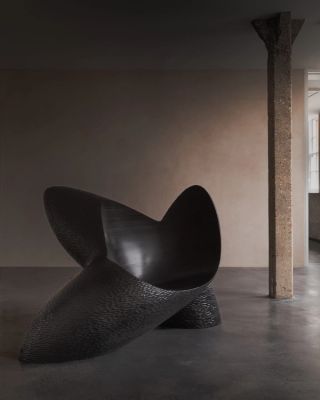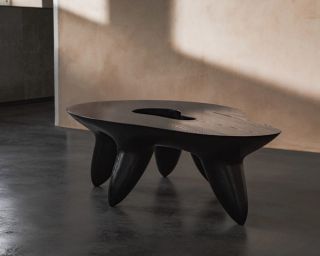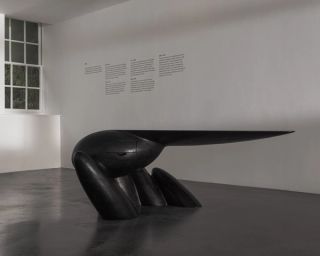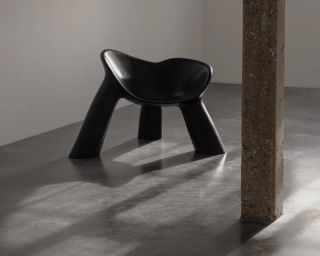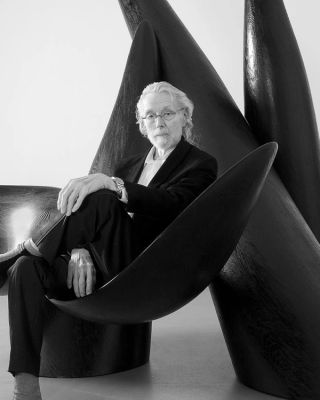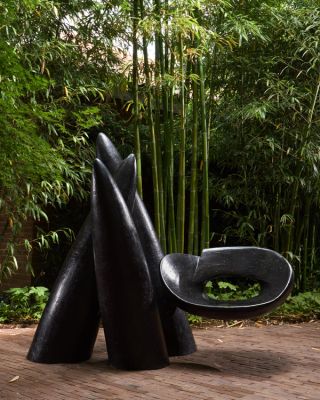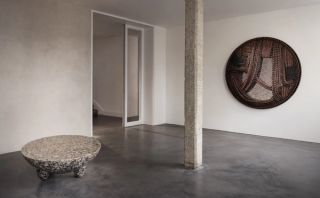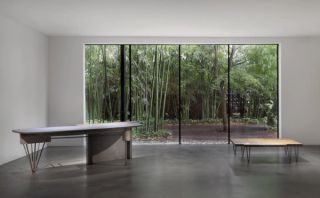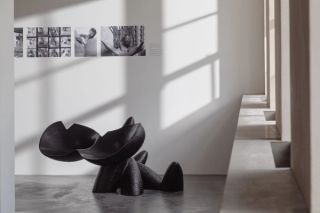
At the heart of this exhibition lies an exploration of Castle's sculptural works made between 2011 and 2015. Exemplifying his departure from the static nature often associated with modernism, this period was marked by fluid, organic sculptural forms that utilised digital methods, including 3D modelling, scanning and laser cutting.
Known as one of the first artists to blur the line between art and design, each piece demonstrates Castle's distinctive and organic approach to sculpture, notably his groundbreaking technique of carving into stacked wood, known as stack lamination. This innovative method begins with large wooden blocks meticulously glued and clamped together, only to be skilfully carved into functional sculptural works of collectible design.
The resulting creations vary in composition, from bulbous to sinewy and serpentine, yet consistently maintain a delicate balance that is a hallmark of Castle's artistic vision. His investigation into different shapes is not only a testament to his technical prowess but also imbues his pieces with a playful and imaginative quality, therein challenging traditional furniture-making norms and establishing Castle as a visionary in the field.
Embracing technological developments in his later life, Castle was able to use both stack-lamination and digital modelling techniques to maximise the abstract volume of his artworks. This is evident in Suspended Disbelief (2015), where spires counterbalance a long, gravity-defying cantilevered tabletop, spanning over four metres in total.
Other key works include Keeping Promises (2012), an anthropomorphic work that invites the viewer to take a seat in its cave-like cocoon and Hope (2013), a textural structure that’s been meticulously crafted from stained ash into sensuous curves, reminiscent of tree trunks and lily pads.
Castle’s taste for innovation emerged during his study of sculpture and industrial design at the University of Kansas in the late-1950s. Utilising walnut sourced from a nearby factory, he laid the groundwork for his organic approach to design, inspired by contemporaries like Finn Juhl and Carlo Mollino. Castle’s artistic journey, from the gravity-defying structures of the 1960s to the later exploration of classical forms and experimentation with trompe l’oeil, reflects a consistent commitment to pushing artistic boundaries. The exhibition presents a unique opportunity to witness the evolution of Castle’s work, showcasing his mastery of materials.